Essay 6: “Romanticism’s Quest for Awakening via Art, Music, & Literature.”
In essay 4, I spoke of how the western philosophical tradition exclusively placed a premium on the rational mind as the key to higher knowledge, but that’s not strictly correct. In the late 18th Century and throughout the 19th Century, the philosophers of Romanticism had a major voice that favored Art at the vanguard of the quest for truth and meaning. According to the Romantic philosophers, civilization’s progress could be best accomplished by refining people’s sensitivity to both the beautiful and the “sublime”—the sense of awe triggered by the sheer power of nature.
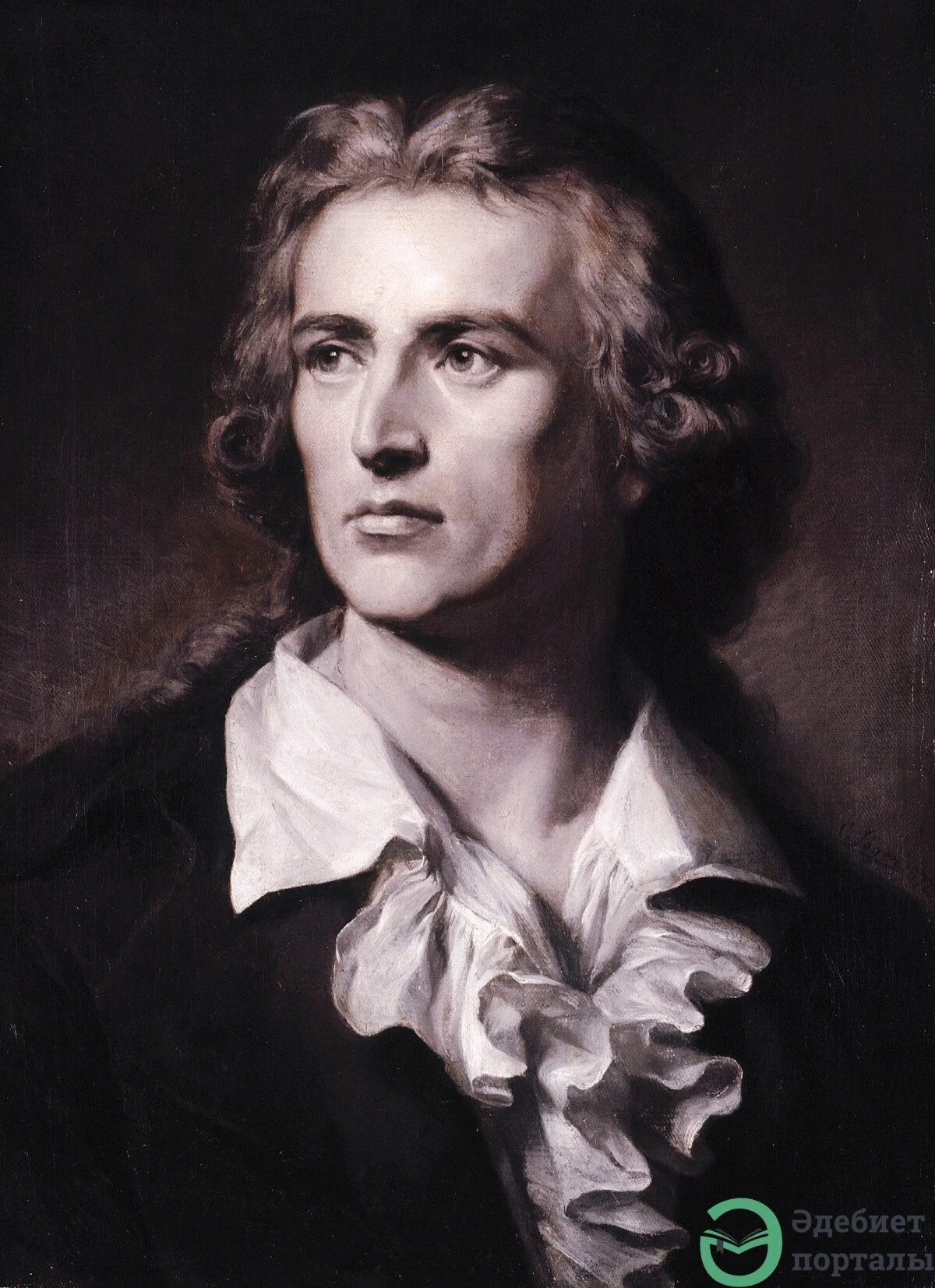
Friedrich Schiller, in the On the Aesthetic Education of Man (1795), contended that the rational mind is a tool that can be deployed to any purpose, but the aesthetic sensibility opens the mind and heart to the most meaningful form of truth. He believed that as people are exposed to great works of art, music, and literature, a spiritual consciousness expands within them, causing them to develop a deeper sense of identity with the world based upon the spiritual interconnectedness of all things. In short, as their consciousness grows, so does their moral sensibility, their conscience—with both words deriving from the same latin root, conscientia, meaning “joint knowledge.” And this same perspective—of the value of beauty, beyond either decoration or entertainment—was summarized in 1819 by John Keats, in his poem, “Ode to a Grecian Urn,” where he wrote: “Beauty is truth, truth beauty—that is all ye know on earth, and all ye need to know.”
The Romantics, based on this philosophical position, sought to fill the world with Art and beauty. They had grown tired of creating art and music only for the aristocracy, seeking instead to enlighten the general population by making their work accessible to everyone. Beethoven is renowned as the first major composer to write music primarily for himself rather than one or other patron, but his true goal was to then express the ‘truth inherent in beauty’ to the public through concerts that he himself arranged. By the way, he also positioned his piano on the stage so that the keyboard faced the audience, allowing them to see his technique. Other great virtuosos of the Romantic period, including Chopin, Liszt, and Paganini (still unequaled as a violinist), helped shape the view that virtuosity was incarnated proof of an artist’s closeness to the spiritual center of all things, a divinely infused aptitude. It was as if the audience were actually listening to God, with the musician acting only as a channel. And given this interpretation of music, we can understand Beethoven’s bold pronouncement that, “Music is a higher revelation than all wisdom and philosophy. …. [for] Music is the one incorporeal entrance into the higher world of knowledge which comprehends mankind but which mankind cannot comprehend.”
But music and the arts were not the only methods by which the Romantics believed a person could attain the undiscovered world of pure spirit. Nature for them was pure spirit made manifest, God’s will made incarnate in physical forms. This was the philosophical view of Ralph Waldo Emerson, Henry David Thoreau, Margaret Fuller, Emily Dickinson, Walt Whitman, and other New England Transcendentalists, whose views were in close resonance with those of Schiller, Schelling, Coleridge, and other Romantics across the Atlantic. Emerson believed that time spent in nature reconditioned the human mind and heart away from the bad habits inherited by urban populations. Coming into tune with the ways of nature was—like music, poetry, and art—a viable route into truth, beauty, and the “Over-soul.” Thoreau, Emerson’s student, spoke of the “tonic of nature,” and Whitman wrote, “Now I see the secret of making the best person; it is to grow in the open air and to eat and sleep with the earth.”
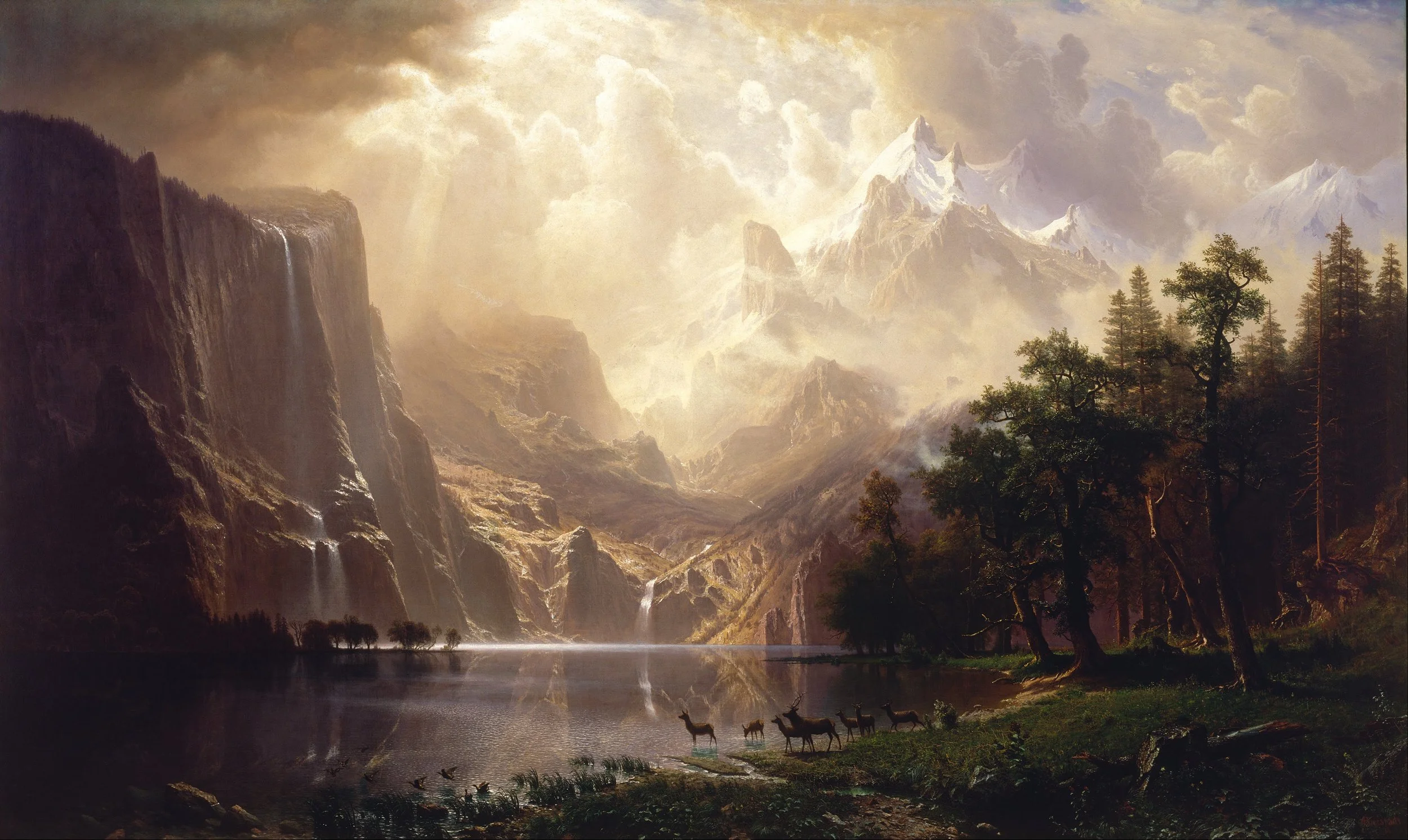
Schiller helped spur a blossoming of poetry and music in Vienna; in fact, his poem “Ode to Joy,” celebrating the themes of unity, brotherhood, and bliss, was used by Beethoven as the lyrics of the last movement of his 9th symphony. But the Transcendentalists focused on the wilderness as the most readily available ‘dharma gate’ for Americans, given that in the 19th Century, the ‘great outdoors’ was literally everywhere in America. And as the movement developed, the examples of nature taken to be most efficacious for triggering a sense of the sublime and the beautiful were high mountains, rushing rivers, huge waterfalls, and other “wonders of nature.” In the paintings of Thomas Cole, Frederic Church, Albert Bierstadt, and other members of the Hudson River School, we find Emerson’s Transcendentalism embodied in pigment. Furthermore, these works of art became so meaningful for the American public—based directly on the Romantics’ conception of beauty as truth—that our national parks system was inspired by them. At the end of the 19th Century, when railroads finally made the ‘wild west’ accessible, Albert Bierstadt’s paintings of the Yellowstone Valley and Yosemite were made into posters for the tourist trade—even as calendar art of the same scenes were produced for those who stayed at home. On a personal note, I was born and raised in Maine, near where Frederic Church once painted the cliffs of Mount Desert Island, now the home of Acadia National Park.
Though Romanticism’s view that ‘civilization’ and ‘technology’ are largely a corrupting influence on people was jettisoned by philosophy in early the 20th Century, as was their contention that physical existence, including our own, springs from a transcendental, spiritual foundation, their works of art, music, and literature continue to inspire—and we find echoes of their sentiment in the works of Annie Dillard, Wendell Berry, and others.
During my decades at the Maine College of Art & Design, I regularly taught an honors seminar on the philosophy of the Romantic movement, for the obvious reason that it honored Art—the life choice of my students—above all other human pursuits. My hope was that understanding Romanticism’s aims could help my students hold their heads a bit high. Today, our culture puts a premium on STEM courses, based mainly on their value for commerce, but wealth takes many forms. I’ll stand with the Romantics, the Transcendentalists, and the Perennialists, that feeding the soul is at least as important as filling the belly, and I salute the bumper sticker that claims, “The best things in life are not things.” Aldous Huxley once said, “Too often, the acceleration of progress is really just a progress of acceleration,” by which he meant that we, via technology, keep moving faster and faster but really have no idea where we’re going. If we could slow down a bit, take a breath, and stop training our children, via advertising and endless coveting, to realize they have deeper needs than bright shiny objects, we might find these earlier souls were not pie-in-the-sky idealists but pragmatists of a higher order. I, as a Perennialist, see the Romantics and Transcendentalists as kindred spirits, agreeing that there’s a wilderness on both sides of our eyeballs and the human project, at its summit, is to connect the two.
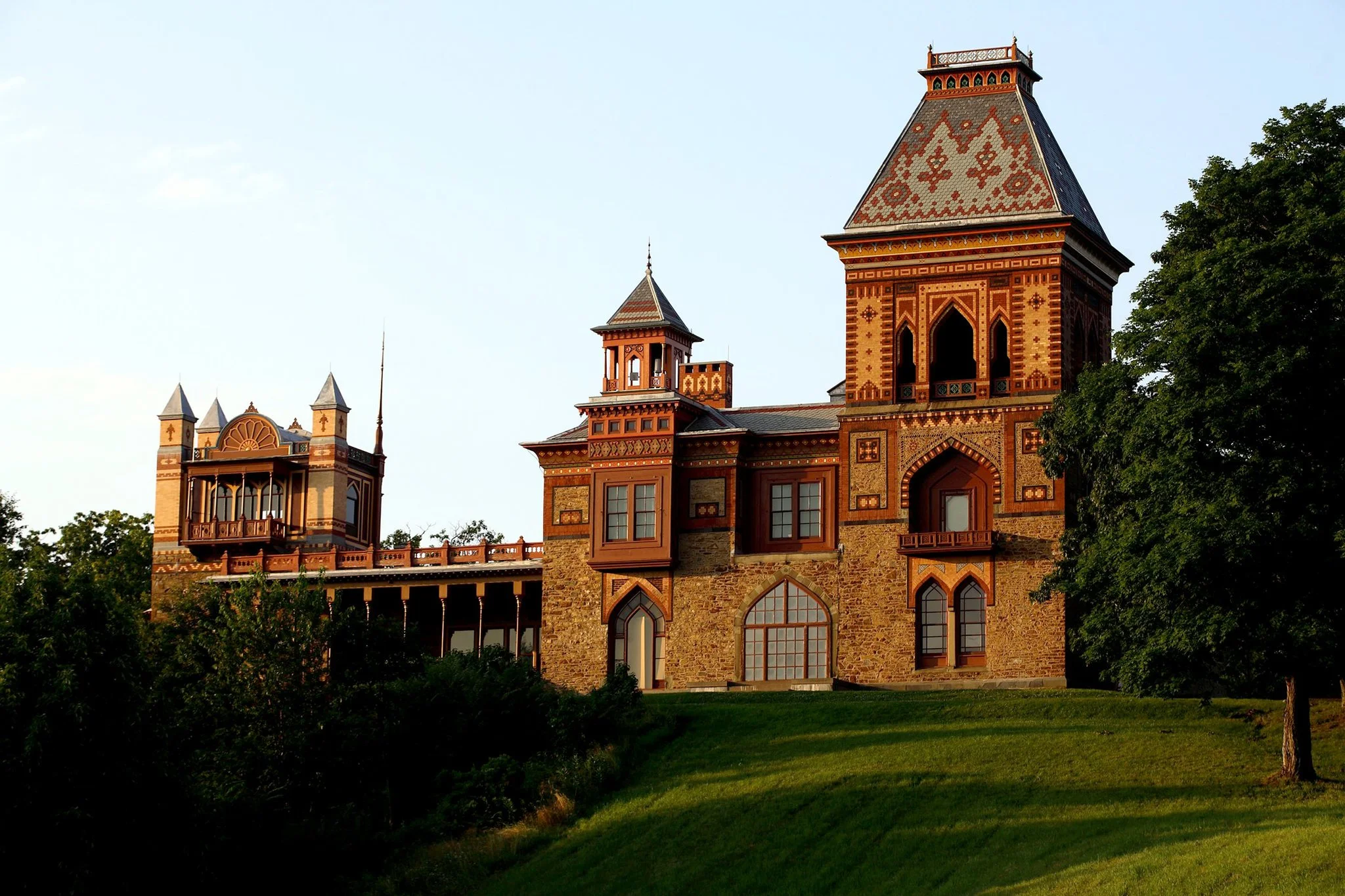
Quick notes on the pictures I’ve included: the first is of Friedrich Schiller, the second is Albert Bierstadt’s painting of the Sierra Nevada, and the last is of Olana (https://olana.org/), the wonderfully romantic chateau of Fredric Church, now a state park located in the upper Hudson Valley of New York.