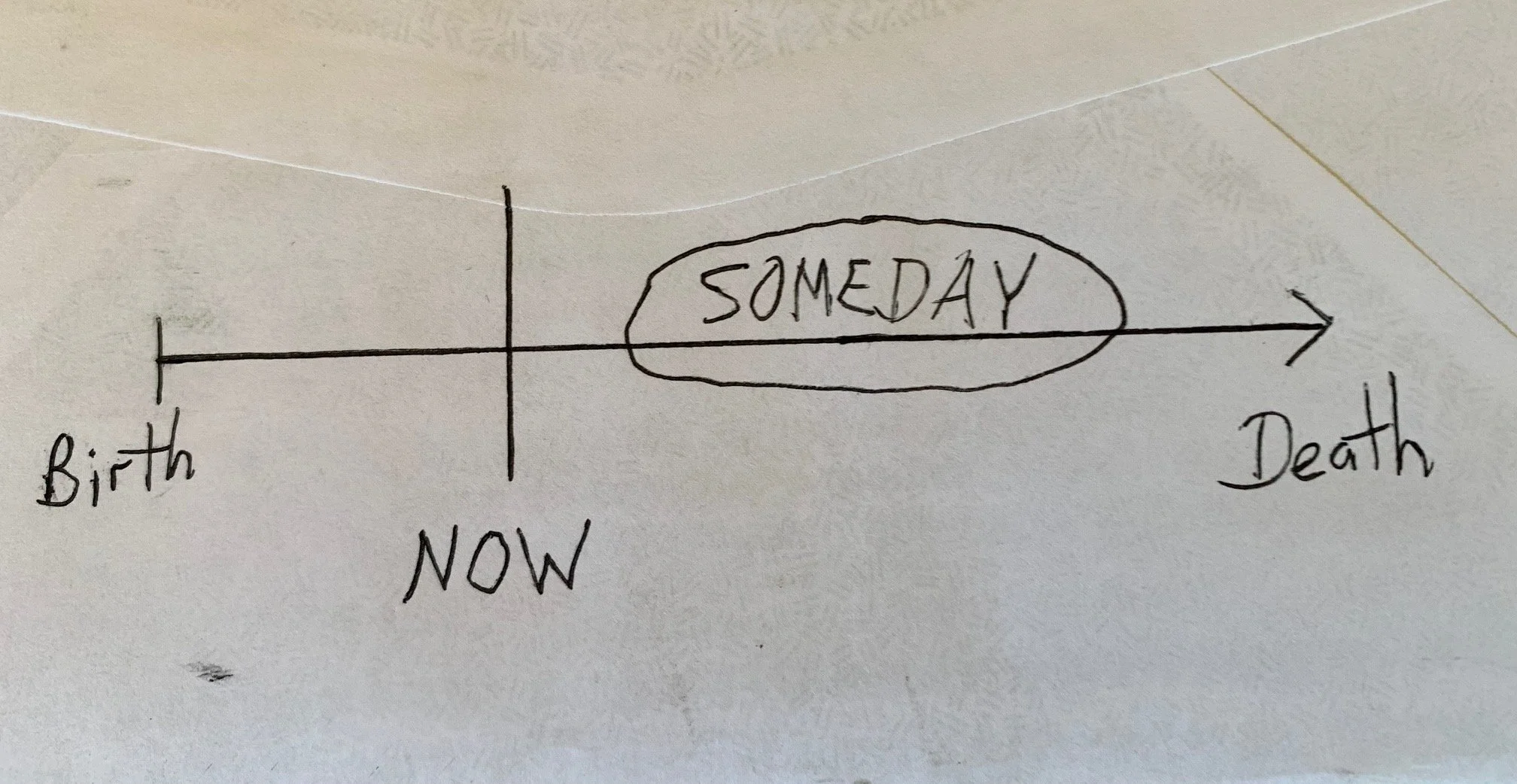
Essay 7: “The Myth of Someday”
When I was a teenager in the 1960s, I mostly read science fiction, but my dad got me interested in the work of Knud Rasmussen, a Danish explorer and anthropologist. Rasmussen was born and raised in Greenland and learned to speak the local Inuit (Eskimo) language, then, after his college education in Denmark, he launched five expeditions to the arctic region. During the first “Thule Expedition,” in 1912, he and his small team mushed more than 620 miles across polar ice to test Robert Peary’s claim that a channel divided ‘Peary Land’ from Greenland. They proved that it was not the case, but nearly died in the process, losing all of their dogs. Five other expeditions were to follow, and I eagerly read about all of them, but what most blew my mind about Rasmussen’s travels were his amazing reports on Inuit culture—especially with regards to their concept of time.
Rasmussen explained that the Inuit had no idea of the future, so their language included no future tense—nor did it include a past tense. Everything for these people was occurring in a constantly expanding ‘now.’ Rasmussen speculated that their lack of “yesterday, today, and tomorrow” may have resulted from the fact that they didn’t experience the same regular sequence of day and night found closer to the equator. If “day” is when it’s light outside, the Inuits, in summer, had ‘days’ that were many weeks long; and if ‘night’ was when it’s dark outside, they had ‘nights’ lasting more than a month. However, the explorer also pointed out that the ‘past’ and ‘future’ don’t actually exist. The past is simply a collection of memories, while the future is a collection of thoughts and projections, with neither having what philosopher’s term “ontological viability.” For instance, when the future becomes a reality, it is then the present and no longer the “future.” Consequently, as Rasmussen pointed out, whole populations of humans, all over the world, never thought up “the future” because it has no external referent in reality. But who cares, you may ask? Well, for one thing, focusing on the future can be dangerous when you’re mushing across the ice.
During one of Rasmussen’s long trips by dog sled, he and an Inuit friend were traveling back to their base camp. It was a long trip of several days, but they had almost returned, when suddenly the Inuit stopped the sled and began untying the dogs. Rasmussen asked him what he was doing. The Inuit pointed to the sun hovering just above the horizon and said, “Igloo building time.” Rasmussen figured they were only a couple of hours from their destination, so he protested, explaining that they would arrive before they could ever have time to build a proper shelter for the night. But the Inuit wrinkled his nose and pointed at the sun again—“It is right there. Don’t you see it? Igloo building time.” Rasmussen quickly realized his friend was so intimately connected to the natural world and the present moment, that he wasn’t thinking about what might happen if they ignored “igloo building time.” Moreover, the explorer saw the wisdom in his friend’s commitment to the present moment, for if anything at all prevented them from reaching their destination before the sun had totally set, there would be no time to build a shelter before they froze to death.
But what does all this have to do with us—we people who have a strong sense of the future and its relationship to the present? In the world of today, people are arguable addicted to the future, caring not whether it actually exists or not. “Tomorrowland” exists as a concept, and that concept has cultural consequences, so it should be taken seriously.
From a very early age—even before we can grasp the concept of the future (at around the age of 4 or 5)—we have been taught to put a premium on it. Several years ago, I saw a New Yorker cartoon that summed the whole thing up; there was no caption, it was simply an image of the back of a black Mercedes sedan, with stickers on the rear window that read, from the top down, “Harvard MBA, Amherst College, Eaton Academy, Mother Goose Nursery School.” The pedigree of the person in the car’s first thirty years were spelled out in the steps they had taken into their successful future, with each step after “Mother Goose Nursery” the prerequisite for the next. Did these steps, which demanded the person keep their primary attention on what was coming next (at least if they worked hard), lead them to the promised land of happiness? In a nutshell, was their “success” a perfect synonym for “happiness?” Maybe, maybe not. AND, if they did consider themselves to be happy, what metrics of life satisfaction were they using to decide? Maybe if they had focused on “igloo building time”—focused, as it is, on the present—they would have been happier in the long run. It’s worth considering.
Related to what I have just said, I remember an old television commercial for a gourmet brand of dog food; it involved a young woman, recently out of college, who—we could tell by her dress clothes—was working in the business world. She had just arrived home and was opening a can of food for her golden lab. While putting it in the dog’s bowl, she petted his head and consoled him, saying, “I know you’ve been inside all day, but here’s a treat for you. In a few years, I’ll be able to afford a big backyard where you can play—and you’ll be able to eat this brand every day.” As I watched the commercial, I found myself thinking, “Wow, doesn’t she realize dogs only live a few years? I wonder if the dog would rather have her attention now, while he’s still feeling spry, then in a ‘few years’ when he’s mostly spent.” And I also wondered whether or not the little girl who had grown up to be the woman in the commercial wouldn’t have been happier with a life less committed to postponed happiness and the allure of “someday.”
When we’re in junior high school, we’re preparing for high school, and we might think, “Wow, high school is going to be so cool. I’ll have a girlfriend (or boyfriend) and I’ll be able to drive.” But then, when we get to high school, it’s often not as cool as we projected. Maybe we have acne or, if we’re a boy, our voice hasn’t changed yet—and yes, we now have a driver’s license, but our parents won’t let us use their car. Of course, good things can also happen, but too often, we find ourselves again back into coveting the future. “Things will be great when I’m in college” or “Things will be great when I get a real job” or “Things will be great when I get married” or “Things will be great when I get a divorce!” In all these cases, the attention is on “someday.” Things will be great THEN, but not NOW. In fact, we can’t be happy now because we’ve spent a whole life projecting our happiness into the future. This is why John Lennon once observed, “Life is what happens while you’re making other plans.”
In the western world, we think of time as a line, with the past behind us and the future straight ahead. I can draw a horizontal line representing this trajectory, then, beginning on the left side of the paper, I can put a short vertical line to indicate a person’s birth. Way out at the end of the line, on the right hand side of the paper, I can draw another vertical line indicating the person’s death. Next, I can draw a vertical line where they are now in their life’s trajectory, perhaps one-third of the way along, if that person is the young woman from the dog food commercial. Last of all, I can draw a circle positioned between where the woman is now and the end of the line. Inside this circle, I could write “Someday.” But the worry is that Someday is always in front of her, but she never will catch up to it. The worry is that the line of where she is NOW will eventually overlap with that indicating her death but she never will have found the happiness she had been taught to project into the future.
But how can she—or me or we—undo a lifetime of cultural conditioning? That’s a very big question, but the perennial philosophy may provide at least a partial answer. Perennialists believe that the true source of our happiness is found within us rather than without. The idea here is that the essence of our very being is rooted in the infinite and eternal essence of all Being, and when we experience that essence—e.g., during the unitive mystical experience—it communicates directly to our heart and mind that we are part of everything and everything is part of us. We experience directly that there is something better to be (a deeper grasp of our own being and its connection with all things), but that state exists in what Aldous Huxley called “this timeless moment,” not the future. This apprehension of the eternality at the root of our being sets our daily life inside a richer context, one in which the daily flow of events is addressed from the perspective that—as Zen Buddhists put it—“It is better to travel well than arrive.” We perform our tasks with a sense of well being, without deferring our happiness to the Someday. Happiness is now and always, even at the moment of death, based on an experience of what is now and always.
Is this position true or just pie-in-the-sky? In India, I’ve witnessed the truth of how presence in one’s being inspires inner peace and satisfaction—as well as how it mediates the sting of death. For many months, during several visits, I traveled around with Dandi swamis who literally owned nothing but the rough robes they were wearing, a bowl, and a water jug. This sect of monks only live in their host monastery for three months each year, during the monsoon, when travel is difficult. For the rest of the year, they wander, mostly to holy sites, depending upon the kindness of strangers to provide them with food, while mostly sleeping in rough shelters, including caves. And yet, I’ve witnessed their great joy and humor on many occasions. They own nothing. Moreover, they are aware of how people who own things are actually—more often than not—owned by the things they’ve acquired, having to work hard to keep up with payments, desires, and expectations.
As a last word for NOW, if the present moment isn’t time enough, shouldn’t we ask ourselves why not? Who was ever happy at any other time then the present moment? If we are not happy now, why not? Is it because we haven’t acquired enough? What is ‘enough,’ and what is it enough of? If having lots of money will insure happiness, why do most of the headlines on the gossip rags at the supermarket checkout report that one or other beautiful, successful, mogul or movie star is wallowing in problems? Maybe ‘enough’ can be a simple life that is rich with inner wealth and insight. That’s my story and I’m sticking to it. Right now—and always—it’s “igloo building time.”