
Essay 9: “Understanding the three primary voices in your head in one easy lesson.”
When I first began teaching environmental ethics, back in the early 1990s, I shared the various ways human cultures have viewed our relationship to the natural world. One fact that jumped out at students was how differently members of the same species can view their relationship to nature. Dogs and cats seem to have the same interests, no matter where in the world you find them, but people can be so different, cross-culturally speaking, as almost to seem like space aliens to each other. Why so?
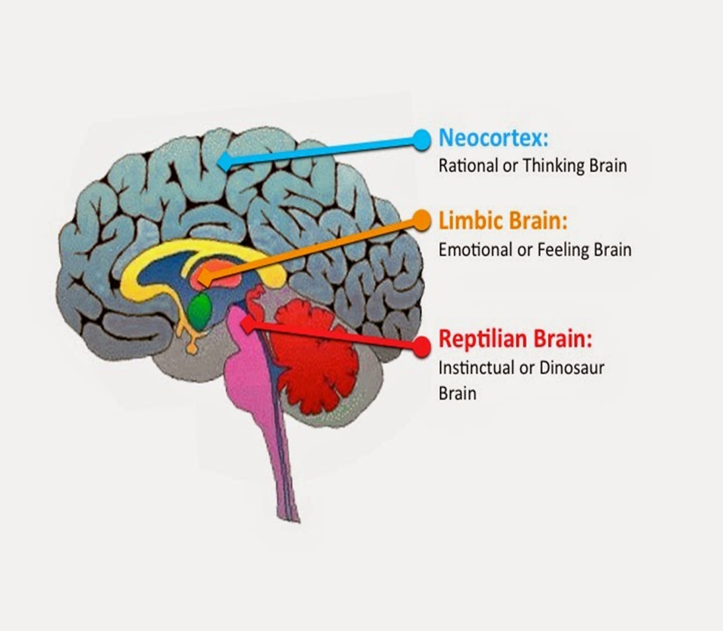
That question can be answered from a range of perspectives, but the bedrock of the issue seems to be located in our physical structure—specifically, in our brains. There’s much to say here, but we can take a shortcut by referencing the Triune Brain Model first proposed in the 1960s. In this model, our brains are comprised of three key components, with the oldest and most basic being the brain stem and cerebellum, i.e., that aspect of brain we share, evolutionarily speaking, with reptiles. This “reptilian brain” controls our heart rate, body temperature, and basic survival instincts—and I mean “basic.” Reptiles are said to respond to all input from the world around them in only four ways, often termed the “four Fs,” i.e., “feed, fight, flee, and—ahem—sexual reproduction.”
On top of the brain stem we find the “mammalian brain,” which broadens our capabilities to include complex emotions, memories, and nurturing behaviors. It inspires our feelings of delight, fear, anger, etc., as it does in all mammals. But on top of the mammalian mid-layer, we find the last addition to the brain, evolutionarily speaking, the cortex and Neo-cortex dealing with language, logic, long-term planning, complex ideas, etc. Saying all this, and acknowledging that neuroscientists tell us that these layers interact in complex ways, why is it important to know about the triune brain? Because it helps us make sense of the range of human cultural differences and why they give rise to so much conflict. Let me briefly explain.
I mentioned that cats and dogs behave similarly in all parts of the world—as do chickens and many other creatures. They perceive “friends” and “enemies” much the same way whether they’re in New York City or Delhi, India, with few, if any, nuances of behavior. But humans, due to their ability for abstract thinking, located in the Neo-cortex, can conceive of friends and enemies in very nuanced ways. If you were to take your pet cat on a roller coaster ride, just for fun, it might be enjoyable for you, but the cat would largely be terrified, wondering what the hell you had in mind. Actually, come to think about it, in some sense you DO take a “cat” with you every time you board a roller coaster, in the form of your own mammalian brain. Note that very often while people are waiting in line for their coaster ride, they experience an increased heart rate and mild anxiety, since their reptilian and mammalian brains are beginning to freak out. “I want to flee,” says the reptilian brain; “I feel scared and want to scream,” adds the mammalian brain. “Shut up, you cry babies,” demands the Neo-cortex, “This amusement park has its rides checked for safety regularly—Ive seen the certificate for this coaster and read about their low record of accidents in this park, plus I’m in good health. There’s no real danger.” But the more simple aspects of the brain hear all of this rationalizing in the same way that kids in the Peanuts’ cartoons hear adults, i.e., just as a bunch of “Wah, wah, wah.” The upside of roller coaster rides for the Neo-cortex is that it gets a rush of excitement by tormenting the reptilian and mammalian aspects of its brain, even while knowing itself that everything will be all right.
The downside, however, of the Neo-cortex’ complex ability to differentiate riding an automobile off a cliff as an “enemy” from plunging on a roller coaster as a “friend” is that it can form a wide range of conceptual friends and enemies based on whichever worldview, religion, or cultural values it embraces. Humans who are Christians can demonize Muslims as “enemies” and vice versa on grounds too abstract for the reptilian and mammalian brains to comprehend. Secularists and communists can demonize both. Ultra feminists can demonize men, and men in the Taliban can demonize women. Environmentalists can see loggers as either “friends” or “enemies” depending on specific forestry practices. Etc. By now, I’m sure you see my point. Actually, the point I’m working toward is that our endemic problem as humans, based in our brain structure, isn’t in our capacity to think in abstract ways, it’s in our tendency to assume our abstract assumptions of “friend” and “enemy” correspond with realities outside of our heads in unassailable ways. Whereas, in actuality, changes in thought and ideology can easily reform “friends” into “enemies” and “enemies” into “friends.”
In this regard, I’ve always had a great deal of respect for Buddhists, given that they realized more than 2,500 years ago that the problem is simply our tendency to generate “enemies” out of thin air, depending on our conditioned assumptions. The Buddha taught that fundamentally we’re all the same, saying, “All beings want happiness. No beings want suffering.” We are all driven by the same basic needs and wishes. Problems and conflicts arise when we project judgments toward each other based on metrics drawn from our host culture.
Referencing another religious tradition, Jesus of Nazareth endorsed a message of unconditional love, taking up the Old Testament position that we should “Love thy neighbor as thyself.” He did NOT endorse the message, “Love thy neighbor if they agree with you about everything and have the same mental habits of ‘friend’ and ‘enemy’ as you do.”
My view is that if people could simply grasp that we are one species whose survival on this small planet—little more than a speck of dust floating in limitless space—would be best served by realizing how adherence to set notions and judgments isn’t getting us anywhere but gone. If space aliens do indeed exist, what must they think of us? Looking down on our planet, they see a species of mostly hairless primates bludgeoning each other endlessly, causing so much extraordinary suffering and trepidation, in service—in the last reckoning—only to more suffering and trepidation. It’s time to grow up, perhaps adding another layer of grey matter to our brains or taking the Neo-cortex to a psychiatrist until it straightens its act out. In the meantime, Jesus, the Buddha, The Beatles, and Todd Rundgren had it right by setting judgments and hatred aside, stopping to breathe, listening to the pain of others, realizing the negative effect of cultural projections onto others, and embracing that in the final analysis, “Love is the answer.”