Essay 2: “Are Mystics and Artists really just people experiencing extraordinary neurodiversity?”
I rarely talk about my personal spiritual experiences because they are, after all, personal. But recently I was reading an article about neurodiversity and the autism spectrum as an example of it. This got me thinking: are mystics and artists simply people who are neurologically diverse?
William Blake claimed that as a child he had seen a tree full of angels with their wings “spangling every bough like stars.” Jakob Boehme, the medieval German mystic, said he had comprehended the deepest secrets of the universe in a mere second while witnessing the sun’s reflection in a pewter bowl. Teresa of Avila related that she once had a small, fiery angel pierce her heart with a golden spear, leaving her overwhelmed with intense divine love. Ralph Waldo Emerson wrote that while walking in the woods one day, he felt his individual sense of self dissolve, allowing him to merge with the divine “Universal Being” or “Over-Soul.”
In our present age, when the philosophy of physicalism (only physical things are real) rules academia, the authenticity of these mystical experiences—and all mystical experiences—is commonly dismissed out-of-hand, on the grounds that they are delusional projections of the subjective mind. Freud, for instance, argued that the experience of “oceanic boundlessness” is simply an infantile projection based on the embryonic memory of our time in our mother’s womb, when we knew of no separation between ourselves and the world. But what if this is simply wrong? What if mystics are actually neurologically diverse—gifted with a brain map that affords them the ability to see what the rest of us cannot? Could it be that mystics have an innate talent for experiencing extraordinary aspects of reality—in some ways similar to how certain people, for instance Mozart, are gifted with extraordinary musical ability? Furthermore, was Mozart, who wrote his first symphony when he was eight years old, in fact also neurodivergent? I think this might be the case. I say all this not only because we can make such a case intellectually, but based on my own life experience.
When I was a child, I often spent long hours in the forests beyond the edge of my small village in Maine. My town, Milbridge, had a small population—about one thousand people—situated on the northern, rocky coast, with far more trees than citizens. Between the ages of 9 and 12, any summer day found me walking up the brook that ran into the town with my fishing pole. Sometimes I went fishing with my childhood buddies, but often I went alone, and on those days I would usually sit in the forest quietly, not fishing at all. Those days were special to me, not only because I often saw a wide range of animals who would come to the brook to drink, but because I often experienced a profound shift in my consciousness—not unlike that experienced by Emerson.
As a boy, I had no understanding of philosophy or theology, and these experiences didn’t register even as “spiritual,” they were simply natural phenomena that arose in my mind when I became very quiet and opened my heart to the world. Specifically, I would sit by the book and simply watch the surface change of the brook as the water flowed by, or I would lie on my back and watch the clouds move slowly through the sky, far above the green canopy of the green forest. Then, without any intention to make it so, I would dissolve into a sense of timelessness and oneness with the world around me. I had no idea of what ‘normal’ was (as is typical of children), so I wasn’t afraid of these experiences—in fact, I reveled in them. However, I soon learned that I had to be careful of who I discussed them with.
When I shared my experiences with my buddies, they looked at me like I had two heads, so I quickly learned to stop sharing. Once, when I was about ten, I was so excited about an afternoon I had spent in the woods, I told my mother the details. “What did it feel like?”, she asked me, showing not only interest but concern. We lived by the sea, on the Gulf of Maine, with its huge tidal change. I told her it was like I had been a tide pool, with just a small world of things inside me, but then—when the experience occurred—I became flooded, like a tide pool swamped by the incoming tide. I became swamped “but I also felt expanded,” finding no separation between myself and everything else. “It’s nice.” She looked at me quizzically, but to her credit she didn’t dismiss my experience of being “flooded” as nonsense. Perhaps she thought I’d simply outgrow the experience—the way kids commonly outgrow their imaginary friends. She coached me to keep the experience to myself, worrying perhaps that people might think me “strange” or “touched.” I’ll only add here that a few years later, when I was fifteen, she remembered my childhood experiences and, after considering them, named my high school rock band “The Mystics.” I took that as an affirmation.
These experiences dwindled during my teen years, occluded by my interests in music, basketball, and girls, but they haunted me. Then, during my college years, I learned that there were schools of philosophy and religious traditions that put a premium on such experiences, seeing them as highly beneficial. For instance, in Christianity it’s a variety of the “beatific vision” or union with God; in mystical Judaism it’s devekut or “cleaving;” and in both Hinduism and Buddhism it’s the experience of samadhi—ego transcendence or dissolution into reality—a step in the direction of bodhi or spiritual enlightenment. Investigating these traditions lead me to try meditation, yoga, and psychedelics, and the “flooding” experience sometimes returned—in fact, it sometimes returned to such an extent that studying theories of its significance became my life’s work. But that work is not the focus of this essay; my point is actually a question: were my experiences also triggered by neurodiversity? I’m guessing that they were. In fact, I’m guessing that artists and musicians—as well as mystics—are often neurologically divergent, for they too have non-ordinary experiences that register as mystical. Moreover, artistic compositions sometimes trigger these experiences in others—suggesting that many people may have a ‘mystical capacity’ existing, however latently, inside them.
Aldous Huxley, the primary proponent of the perennial philosophy as we know it today, argued that mystical experience and aesthetic experience may not only be close cousins but actually the same experience in different contexts and with different intensities. The fact is that aesthetic experiences sometimes become so strong that they trigger mystical experiences of unity and oneness. Hildegard of Bingen, a medieval mystic, composer, and musician, related that she experienced and created music based on her divine visions, viewing her musical compositions as a bridge between the divine and the worldly. Regarding visual art, I myself have had the “flooding” experience while looking at paintings—and I’m guessing many of you have, too. (Let me know in your comments.) I’ll end this essay with a short story in that regard.
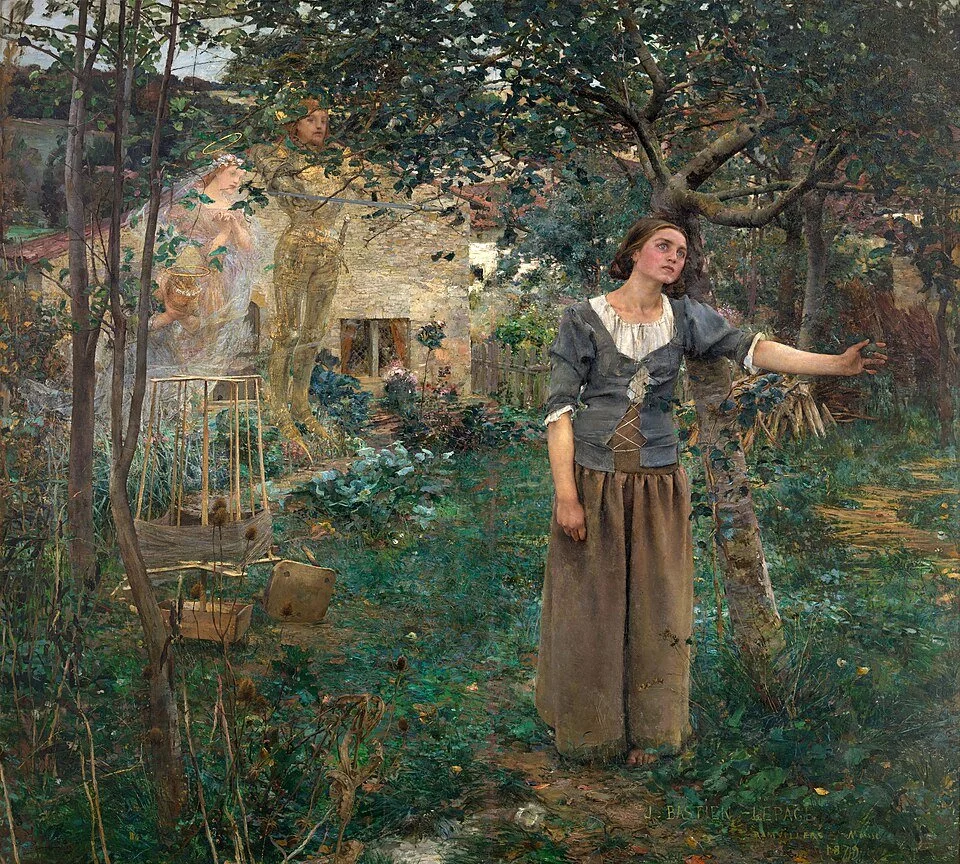
As I said, my childhood experiences of unitive oneness with all things went away for a time, but they began to recur when I was eighteen, specifically after an experience I had at the Metropolitan Museum of Art in Manhattan. It was 1970 and I was attending Western Connecticut State University in Danbury, Connecticut, just an hour north of New York City. While on a trip to the MET with my art history class, I wandered by myself into a gallery with a large painting—about 8’x10’—by the French artist Jules Bastien-Lepage. Painted in 1879, it depicts a life-sized Joan of Arc standing in her garden immersed in mystical reverie with angels filling the trees behind her. What stuck me most was that the look on her face. I found myself exclaiming inside my head, “That’s it! She’s having the flooding experience.” But then a shift came. Looking at her face triggered that experience in me.
I stood there frozen, completely absorbed. Luckily there was nobody around to see me and be worried I was having a seizure or some sort of “episode,” and the experience—which lasted for perhaps only two or three minutes—soon faded. But what has stayed with me ever after was the realization that art can trigger the experience in me as easily as had the forest. Furthermore, I realized that Bastien-Lepage, the artist himself, was likely to be familiar with experience—for how else could he have conveyed it so perfectly? And when I say “conveyed,” I don’t only mean in the countenance of Joan of Arc’s face but in creating a work of art that transported the experience into me and, I’m sure, others. Here was an aesthetic experience that triggered a mystical experience—an experience that I never forgot. But how could I forget, since I’ve visited that painting many times since.
I’ve meandered a bit in this essay, but my bottom line is that I think mystics and artists are among the neurologically diverse population and I celebrate them (ever wonder why I taught philosophy at an art college for nearly thirty years?). Furthermore, I celebrate that humans are not only conditionable creatures, driven by their cultural and neurological habits, but—because of that—re-conditionable. Our neuroplasticity allows us to rewire our brains. My hope is that we, as a society, will learn the best methods for accessing our latent potentialities, including our capacity for realizing our oneness with the world around us. In the perennial philosophy, this ‘flooding’ is generally termed the unitive mystical experience (or UME), but is it anything other than a somewhat groovy event in the mind or does it have real value? In my next blog—coming in the next few days—I’ll drill down on why it’s valuable. Frankly, I wouldn’t care about it at all if it didn’t bode positive changes in people and society.
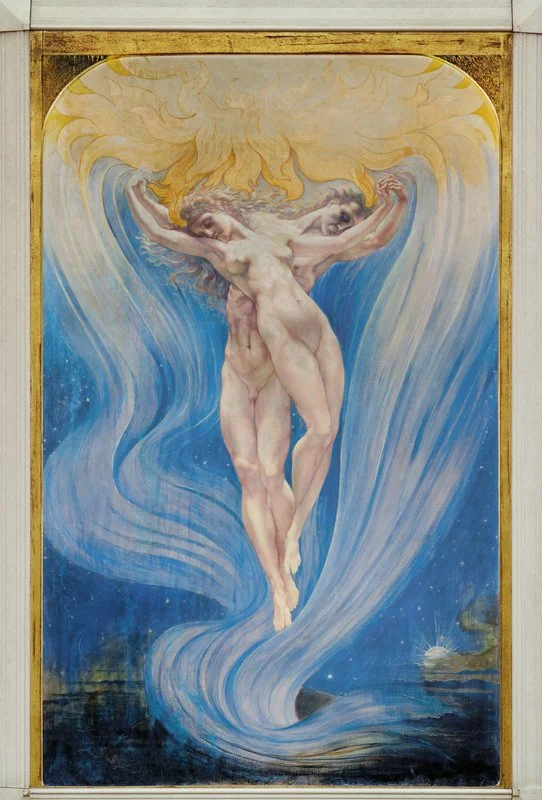
See you soon! And since it’s Valentine’s Day tomorrow, I’m including an image of a painting by Jean Delville, a Belgian mystic, depicting two lovers entwined in their shared experience of oneness with Reality.